 Planetarium 3D
Un cielo realistico
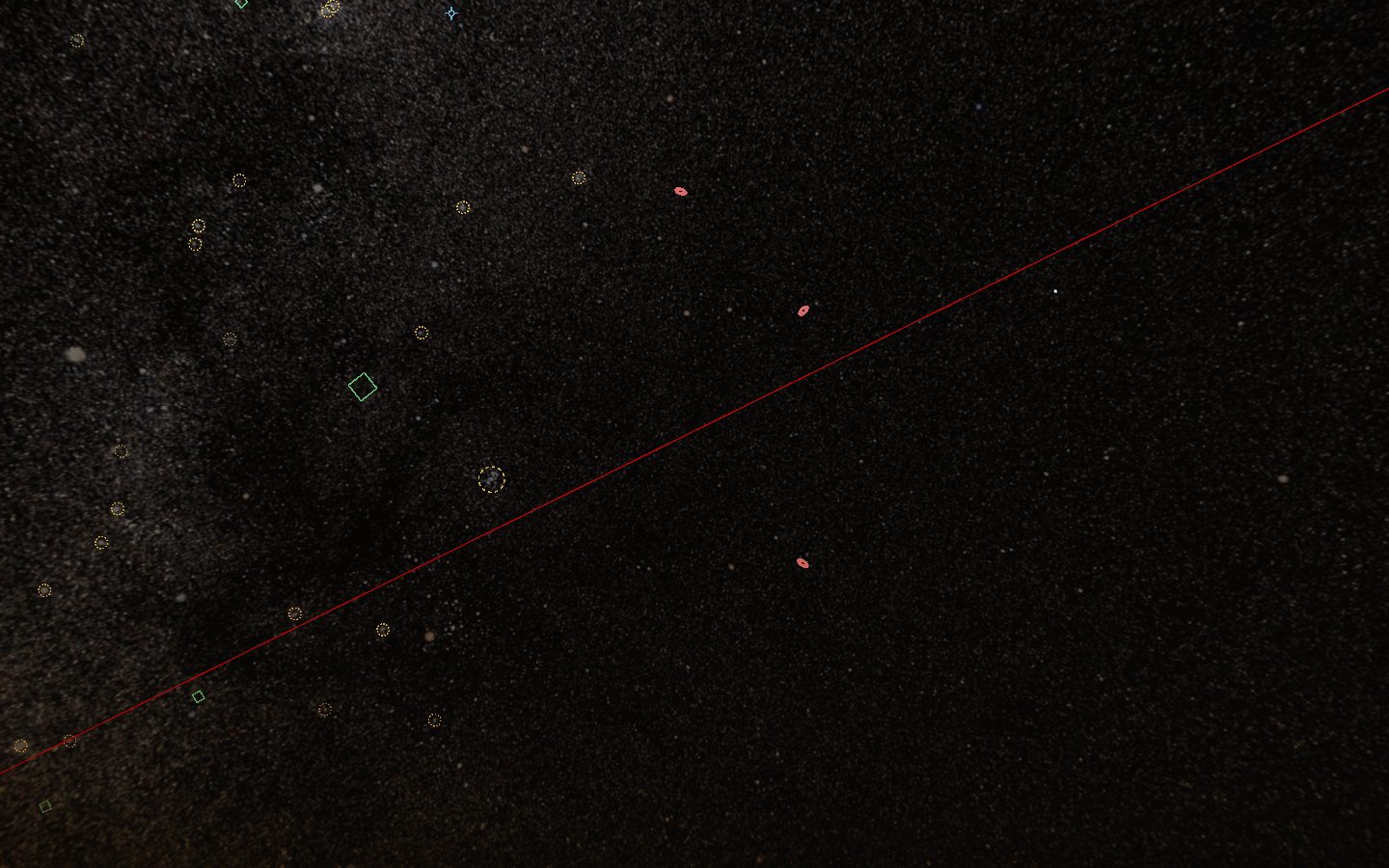
Circa 880.000 stelle (Hipparcos e Tycho-2 fino alla magnitudine 11) con colore e moto proprio, 88 costellazioni, Via Lattea, crepuscolo, inquinamento luminoso, estinzione vicino all'orizzonte e luce della Luna.
Un planetario 3D con stelle, pianeti, galassie, satelliti e comete calcolati per l'istante che scegli, eclissi comprese. Un tour guidato a voce ti mostra cosa c'è stasera, un assistente AI risponde alle tue domande e punta il telescopio per te, e un simulatore spaziale ti fa pilotare una nave verso la Luna e Marte.
Apri il planetarioSimulatore spazialeCosa sa fareA 3D planetarium with stars, planets, galaxies, satellites and comets computed for the moment you choose, eclipses included. A voice-guided tour shows you what is up tonight, an AI assistant answers your questions and points the telescope for you, and a space simulator lets you fly a spacecraft to the Moon and Mars.
Open the planetariumSpace simulatorWhat it doesTutto parte da un motore astronomico in C++ (VSOP87 ed ELP2000) sul server; cataloghi, tour e pianificatore sono calcolati anche nel browser.
Circa 880.000 stelle (Hipparcos e Tycho-2 fino alla magnitudine 11) con colore e moto proprio, 88 costellazioni, Via Lattea, crepuscolo, inquinamento luminoso, estinzione vicino all'orizzonte e luce della Luna.
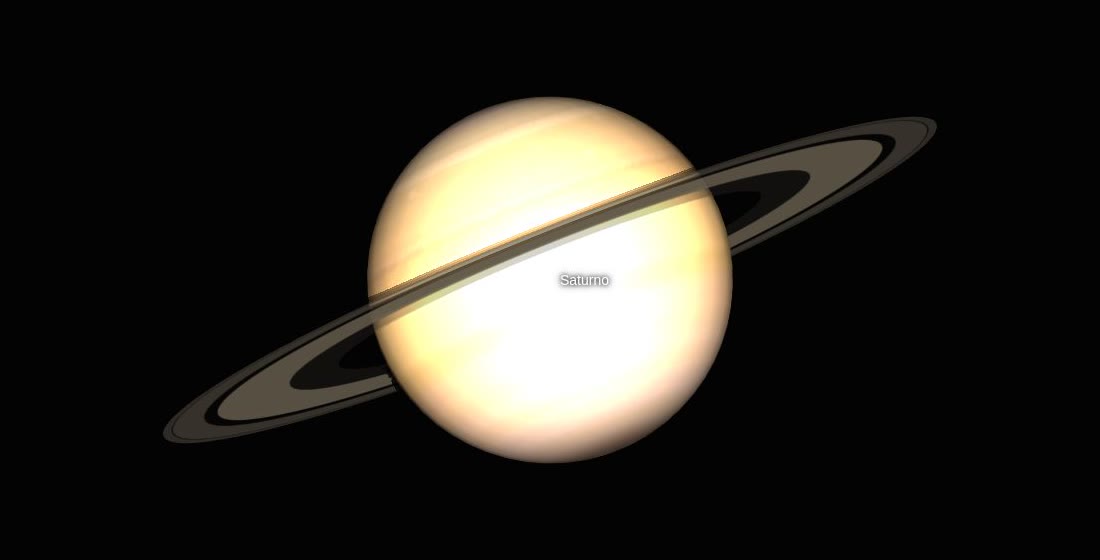
Ingrandisci fino a vedere gli anelli di Saturno, le fasi di Venere, la superficie di Marte e le formazioni lunari con il loro nome. Ci sono anche le lune di Giove e di Saturno, Fobos, Deimos, Plutone e Caronte.
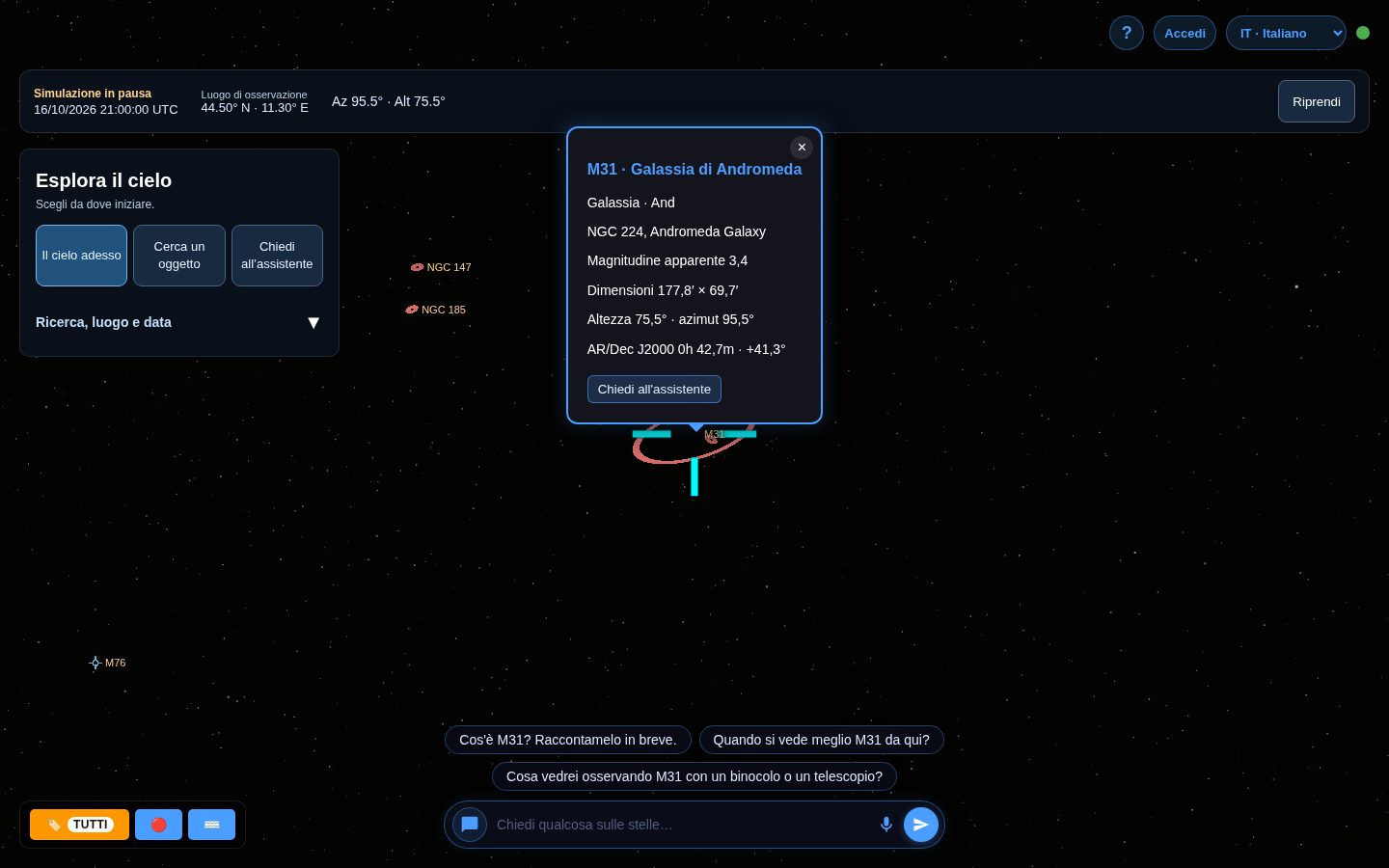
I 110 oggetti di Messier e quasi 1.700 di NGC e IC, con forma, dimensione e orientamento reali. Un clic apre la scheda.
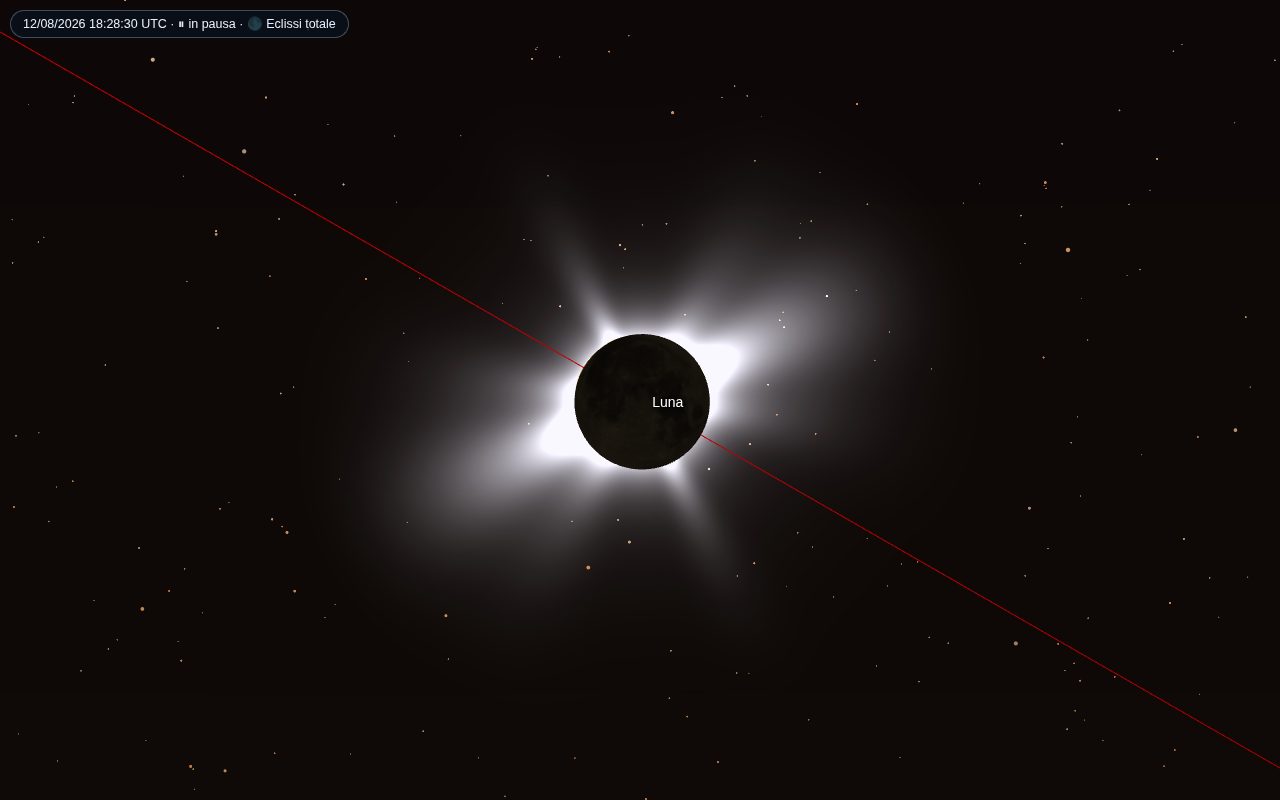
Eclissi di Sole con luce, corona e frazione coperta, eclissi di Luna nell'ombra della Terra, le prossime visibili dal tuo luogo e il replay dei contatti. Qui la totalità del 12 agosto 2026 da Burgos.
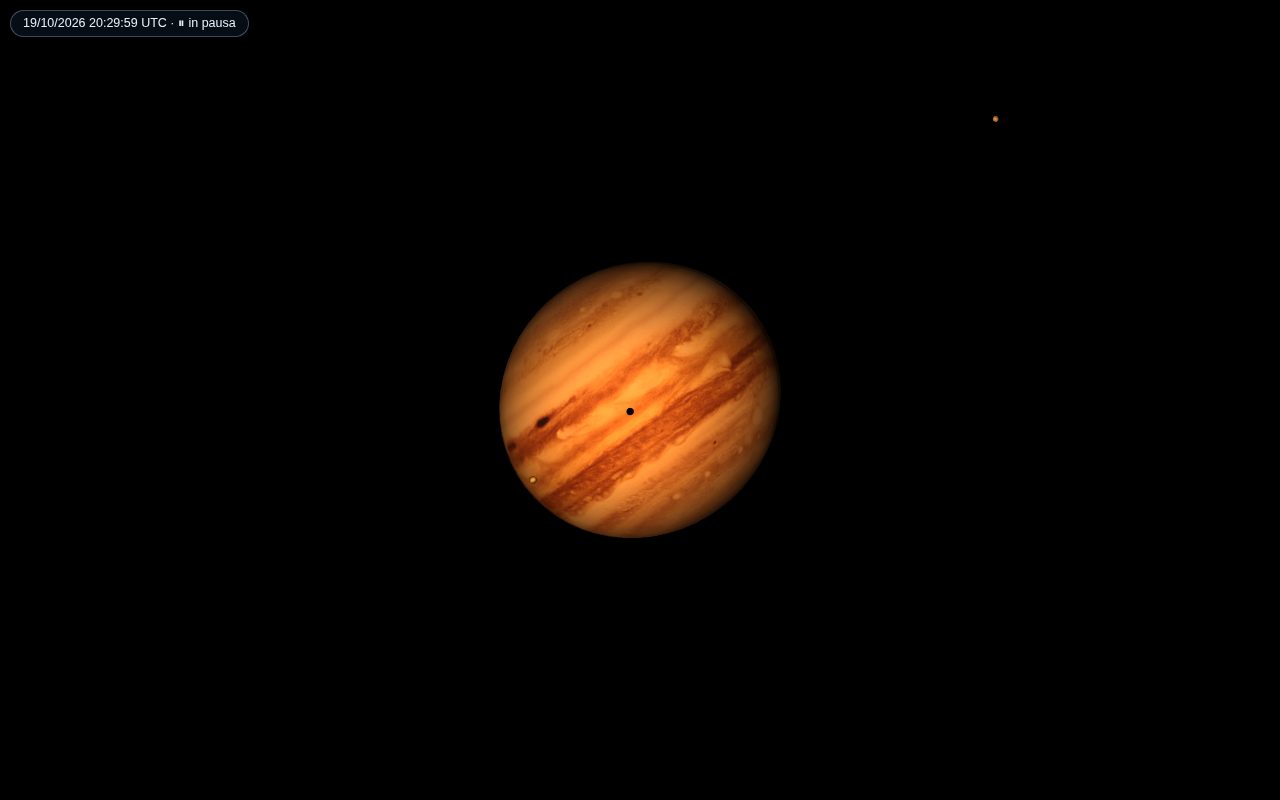
Le ombre delle lune sui pianeti, le eclissi dei satelliti nell'ombra di Giove e di Saturno e i fenomeni reciproci, con una linea del tempo degli eventi.
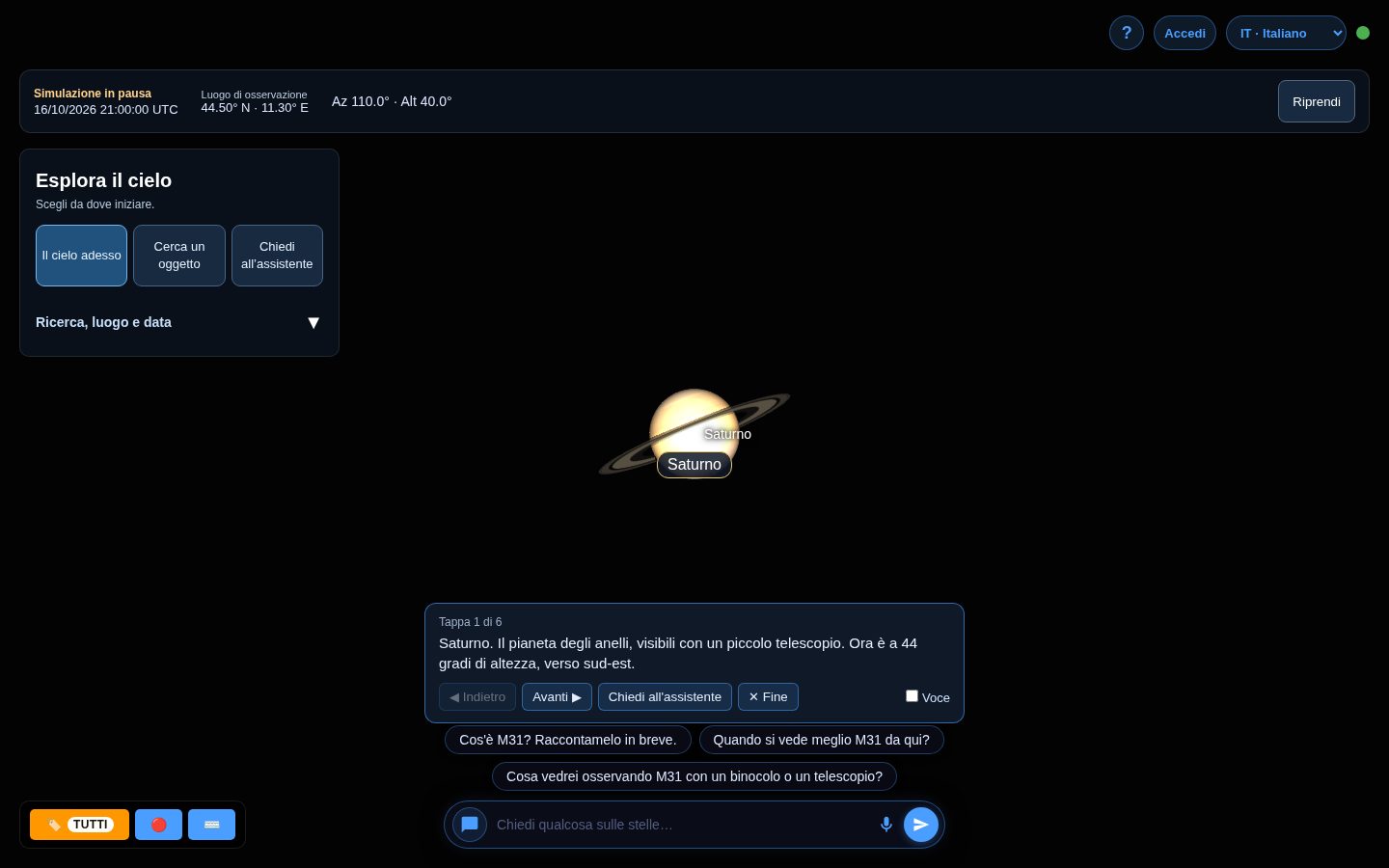
Un tour gratuito a voce sceglie gli oggetti meglio visibili stasera da dove sei e te li racconta uno per uno.
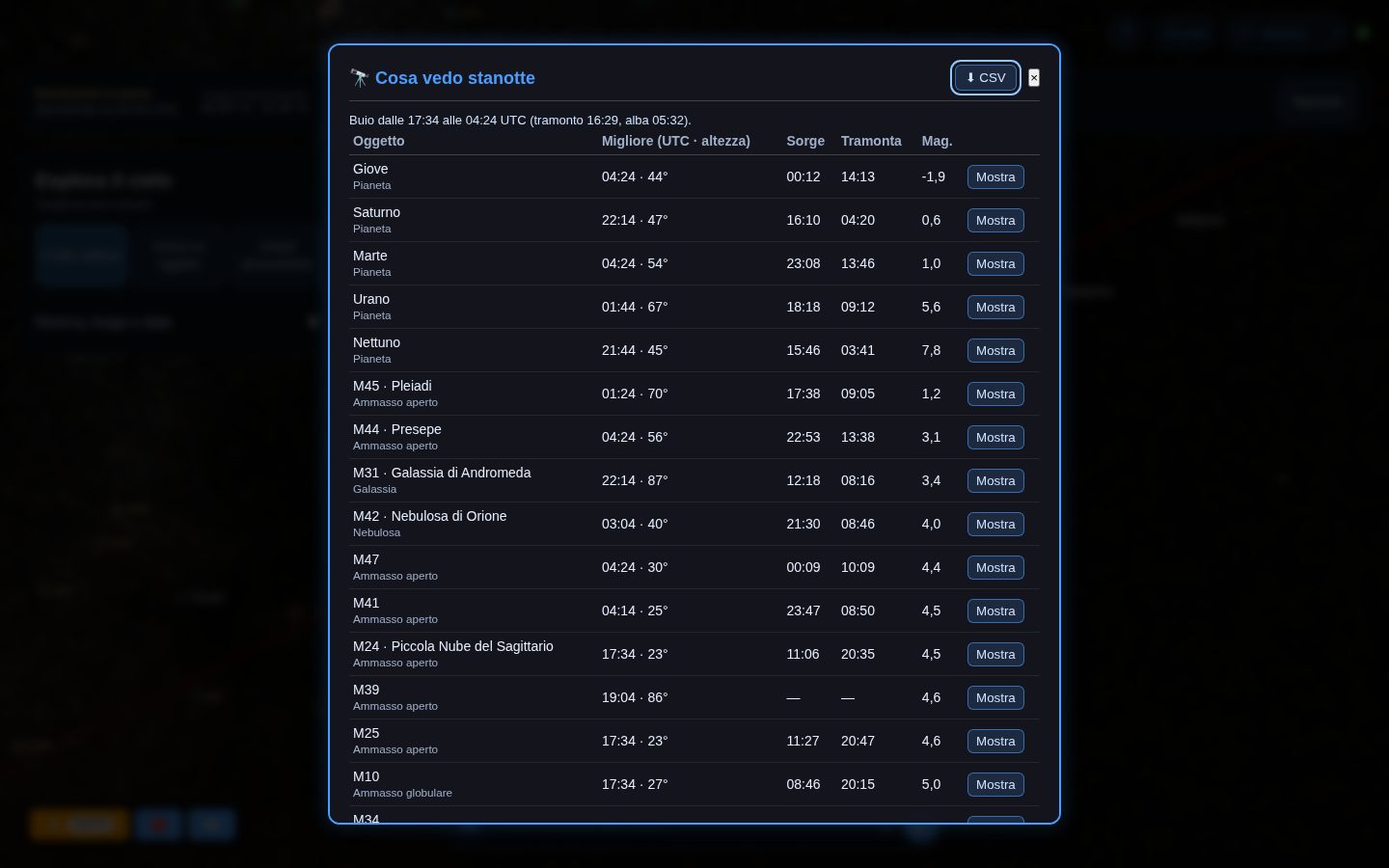
Ora migliore, altezza, sorgere e tramonto di Luna, pianeti e Messier, con il meteo delle ore buie. Diario delle osservazioni e scenari riutilizzabili; si scarica in CSV.
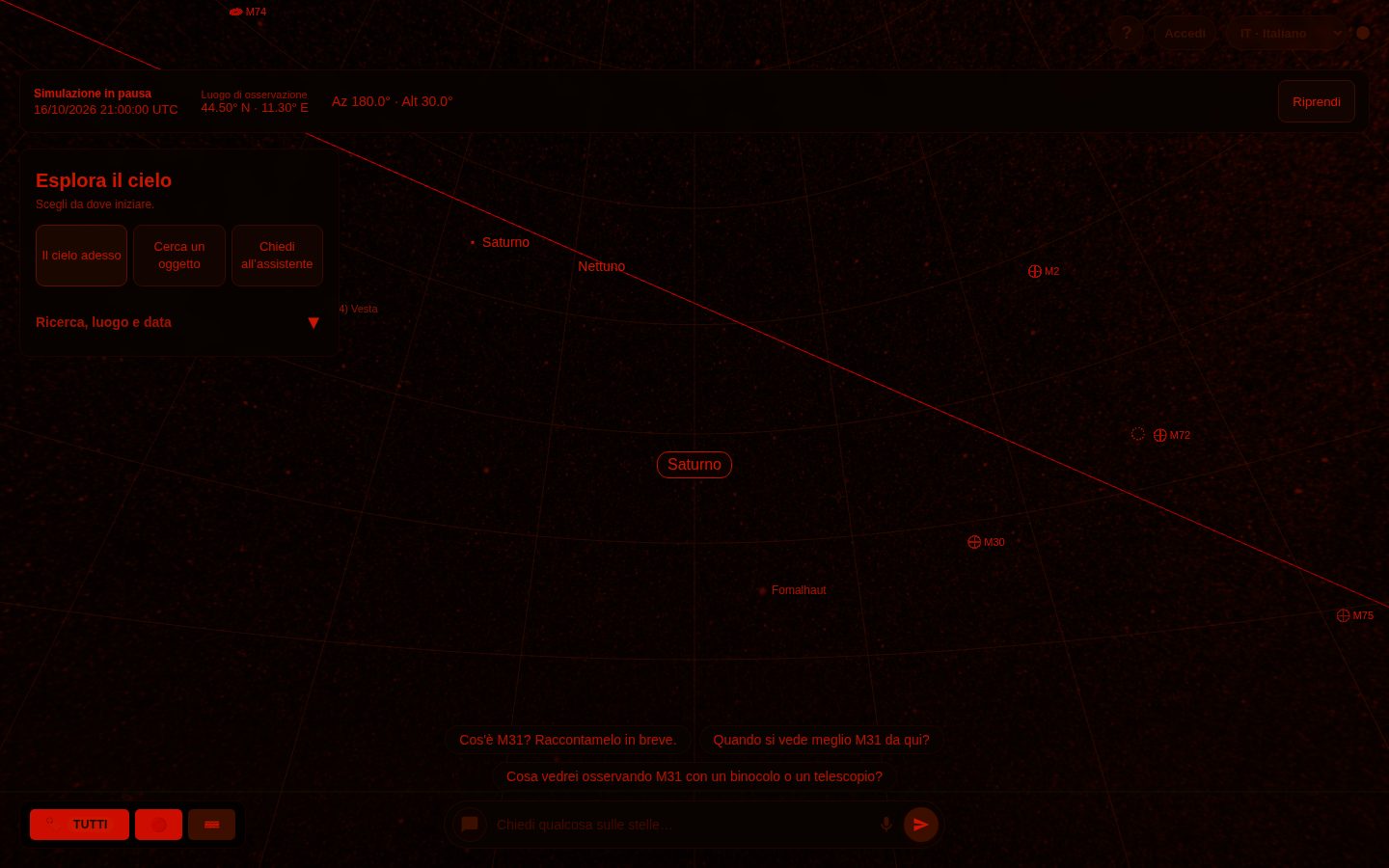
Visione notturna rossa, griglie, cerchio del campo di binocolo e telescopio, ISS e satelliti con il prossimo passaggio, e controllo di un telescopio vero con ASCOM Alpaca.
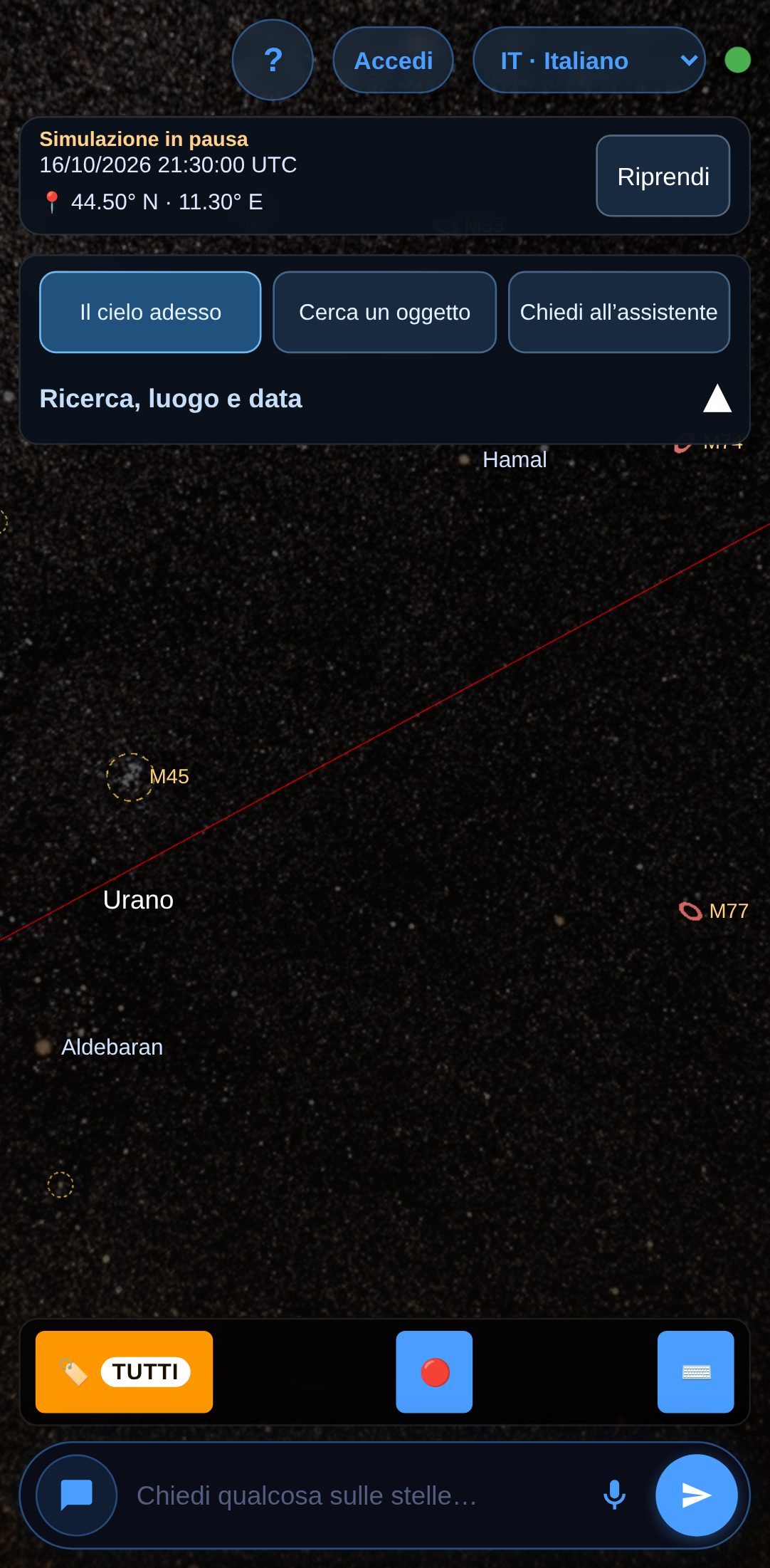
Gesti touch, pannelli su richiesta, modalità «Solo cielo» e «Punta il cielo» con il giroscopio, installabile come app e utilizzabile senza rete.
Everything starts from a C++ astronomical engine (VSOP87 and ELP2000) on the server; catalogues, tour and planner are also computed in the browser.
About 880,000 stars (Hipparcos and Tycho-2 down to magnitude 11) with colour and proper motion, 88 constellations, the Milky Way, twilight, light pollution, extinction near the horizon and moonlight.
Zoom in to see Saturn's rings, the phases of Venus, the surface of Mars and the named features of the Moon. The moons of Jupiter and Saturn, Phobos, Deimos, Pluto and Charon are there too.
All 110 Messier objects and almost 1,700 NGC and IC objects, with their real shape, size and orientation. One click opens their card.
Solar eclipses with light, corona and covered fraction, lunar eclipses in the Earth's shadow, the next ones visible from where you are and a replay of the contacts. Here, totality on 12 August 2026 from Burgos.
Moon shadows on the planets, satellite eclipses in the shadow of Jupiter and Saturn and mutual events, with a timeline of what happens.
A free voice tour picks the best objects tonight from where you are and tells you about them one by one.
Best time, altitude, rise and set of the Moon, planets and Messier objects, with the weather for the dark hours. An observing log and reusable scenarios; download it as CSV.
Red night vision, grids, binocular and telescope field-of-view circles, the ISS and satellites with their next pass, and control of a real telescope through ASCOM Alpaca.
Touch gestures, panels on demand, "Sky only" and "Point at the sky" modes with the gyroscope, installable as an app and usable offline.
Piloti una nave con gravità, spinta e propellente veri: per arrivare alla Luna o a Marte devi pensare a dove sarà il bersaglio all'arrivo e a quanto carburante ti serve per frenare. Le posizioni dei corpi vengono dallo stesso motore astronomico del planetario.
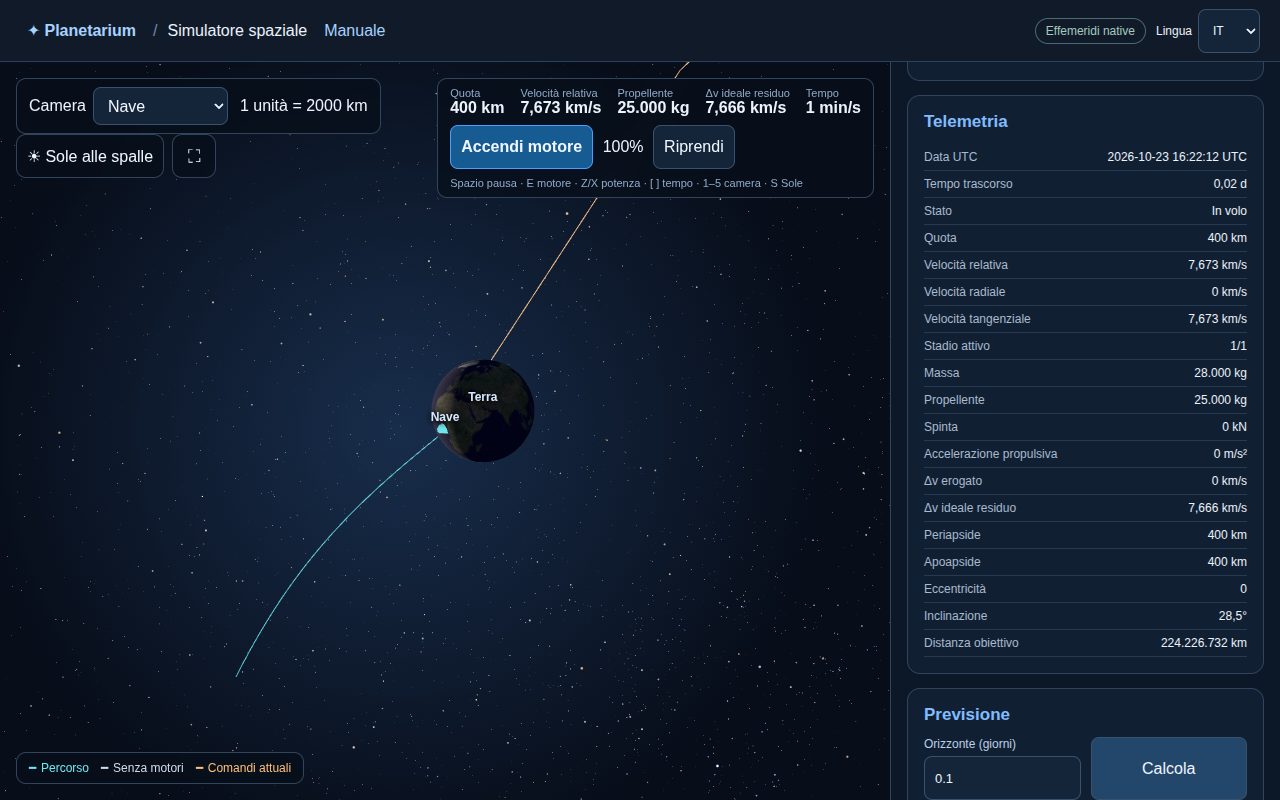
Orbita bassa a 400 km o decollo con un lanciatore a due stadi. Spinta prograda, radiale, normale o fissa, previsione della traiettoria e telemetria completa. La navigazione assistita cerca le finestre di lancio verso la Luna e Marte e verifica partenza, correzione di rotta e frenata.
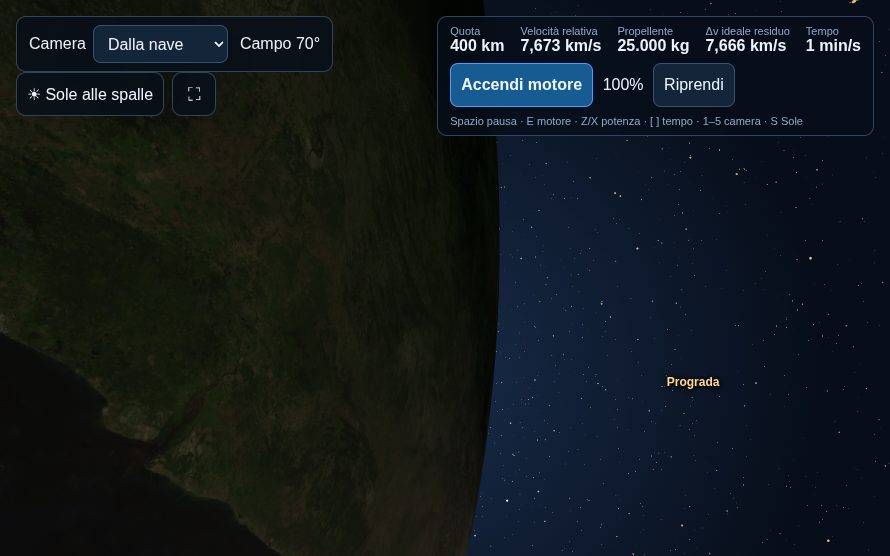
Quello che vede il pilota: circa 41.000 stelle reali, pianeti con mappe e rotazione IAU e la Terra fino a 0,6 km per pixel a bassa quota.
Missione guidataApri il simulatoreGuida per l’insegnanteLeggi il manuale
Fly a spacecraft with real gravity, thrust and propellant: to reach the Moon or Mars you have to think about where the target will be when you arrive and how much fuel you need to brake. The bodies' positions come from the planetarium's own astronomical engine.
A 400 km low orbit or a launch on a two-stage rocket. Prograde, radial, normal or fixed thrust, trajectory prediction and full telemetry. Assisted navigation searches launch windows to the Moon and Mars and checks departure, course correction and braking.
What the pilot sees: about 41,000 real stars, planets with IAU maps and rotation, and the Earth down to 0.6 km per pixel at low altitude.
Guided missionOpen the simulatorTeacher’s guideRead the manual
zoom 20 o lookat Sirius: vanno subito al motore, senza passare dal modello.zoom 20 or lookat Sirius: they go straight to the engine, without the model.Confronti automatici con le effemeridi JPL Horizons della NASA.
| Oggetto | Errore sulla posizione vista |
|---|---|
| Sole e Luna | meno di un secondo d'arco |
| Pianeti | meno di 2 secondi d'arco |
| Lune di Giove e di Saturno | meno di un secondo d'arco |
| Eclisse totale di Burgos, 12 agosto 2026 | totalità di 107 s contro 106 s, contatti entro 15 s |
| Comete e asteroidi | da pochi secondi a mezzo primo d'arco |
| Satelliti artificiali | entro 0,1 gradi |
Automatic comparisons with NASA JPL Horizons ephemerides.
| Object | Error on the apparent position |
|---|---|
| Sun and Moon | under one arcsecond |
| Planets | under 2 arcseconds |
| Moons of Jupiter and Saturn | under one arcsecond |
| Total eclipse at Burgos, 12 August 2026 | 107 s of totality against 106 s, contacts within 15 s |
| Comets and asteroids | a few arcseconds to half an arcminute |
| Artificial satellites | within 0.1 degrees |